Neck and shoulder pain: the warning signs and how to actually relieve it
What neck and shoulder pain feels like at each stage, what causes it, the red flags that mean see a doctor now, and why therapeutic massage relieves it more lastingly than rubbing it yourself.

Neck and shoulder pain rarely shows up out of nowhere — it usually starts as a few passing aches, easy to blame on one bad night’s sleep. The trouble is that once it settles into a pattern, what’s driving it is often more than a single awkward night. This guide helps you work out which stage you’re at, and when home care is enough versus when you need a doctor first.
The most common symptoms of neck and shoulder pain
It usually starts with a similar feeling: a dull ache or stiffness at the back of the neck, most noticeable first thing in the morning or after a few hours sitting still. The pain tends to build with prolonged sitting, poor posture, or a sudden drop in temperature, then eases off with proper rest. Left alone, it can spread further: heaviness across the shoulder blade, tingling or numbness running down the arm and sometimes into the fingers, plus a noticeably stiffer turn of the head.
One thing that’s easy to miss: pain from simple muscle tightness tends to follow a pattern — worse by the end of the day, better after rest or a warm compress. If the pain shows up no matter what position you’re in, even lying down, that’s a signal to check the warning-sign section below instead of continuing to rub it out yourself.
Why so many more people are dealing with this now
The most common cause is still everyday habit: long hours at a desk, looking down at a phone, a pillow that’s too high or too firm, carrying weight lopsided on one shoulder. This mechanical group of causes forces the neck and shoulder muscles to stay contracted just to hold the head up, and over time that turns into tightness and pain. Alongside it sits a rarer but more serious group: cervical spine degeneration, a herniated disc pressing on a nerve root, shoulder joint inflammation — cases that need imaging from a doctor rather than a guess based on how the pain feels.
A sudden cold snap, air-conditioning blowing straight at the back of your neck, or bad form during exercise can also bring the pain on faster than usual.
Who’s most likely to deal with this
The higher-risk group includes office workers, drivers, and people with existing disc degeneration or a congenital spinal irregularity. Hairdressers, teachers who stand for hours, and anyone who lifts and carries goods for a living also tend to report this area often — the job itself forces the neck and shoulders to hold one repeated position all day. If that description fits you and you’ve already noticed the signs above, a session focused entirely on the neck and shoulders will do more for you than a spread-out full-body massage.
When it’s ordinary tightness — and when to see a doctor right away
This is the most important section in the whole article, because massaging at the wrong moment can make things worse. The signs that mean see a doctor now, not later, and don’t self-massage in the meantime include:
- Pain that started after a fall, a collision, or any impact to the neck
- Noticeable numbness or weakness in the hand, harder to grip things than usual
- A stiff neck with a severe headache, fever, or loss of bladder/bowel control
- Feeling an unusual lump anywhere on the head or neck
- Pain with dizziness, shortness of breath, or pain running down the left arm — cardiac causes need to be ruled out first
For milder cases, you should still see a doctor if the pain lasts longer than a week, doesn’t respond to medication, or keeps coming back. If you’re not sure which group you fall into, when you should see a doctor instead of getting a massage breaks it down further before you book anything.
What happens if it’s left untreated
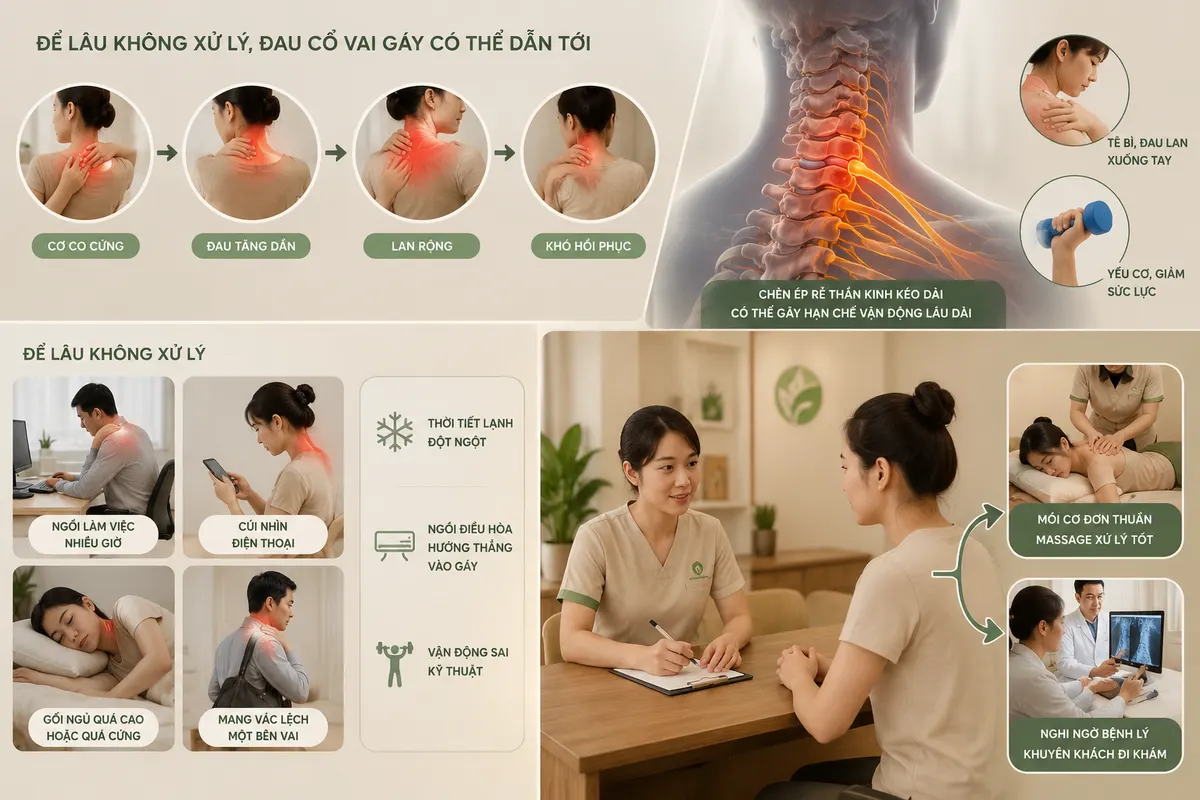
Left untreated, neck and shoulder pain from mechanical causes only gets tighter the longer it goes on, and the ache spreads further — harder to loosen up in a single session. With the underlying medical causes, ongoing nerve compression can gradually weaken the arm and shrink your neck’s range of motion long-term. That’s why Tam Dac always asks about your condition before starting a session: straightforward muscle fatigue responds well to massage, but anything that looks like it could be medical always gets a “see a doctor first” recommendation.
Home remedies and their limits
A warm compress for 10 to 15 minutes, resting, changing your sitting position, gently rubbing the area yourself — all reasonable first response for pain that’s just shown up. The problem is these only work at the surface and only ease the feeling temporarily; the deeper muscle stays tight because the root cause (your posture, your workload) hasn’t changed. That’s why plenty of people rub the same spot every day and the ache still comes right back the following week.
How therapeutic massage actually works on the neck and shoulders
Unlike a light rub at home, therapeutic massage locates the exact muscle group that’s tight — usually the trapezius and sternocleidomastoid — then works through it with a sequence of kneading, pressing and rolling to soften each layer, not just the surface. As the muscle releases, blood flow to the neck improves, the heavy-headed feeling from muscle tension eases along with it, and range of neck motion is often noticeably wider right after the first session. The neck and shoulder package at Tam Dac dedicates the full session to this one area instead of spreading time across the whole body.
Why visually impaired therapists often find the sore spot faster
A visually impaired therapist can often pinpoint almost exactly where it hurts before you’ve said much at all. That’s not a coincidence: without relying on sight, a visually impaired therapist’s sense of touch is trained to pick up on small differences between normal muscle and muscle that’s tightening up, and their full attention stays on how the muscle reacts under their hands instead of being pulled toward anything else in the room.
What a neck and shoulder session at Tam Dac actually looks like
- A short conversation about where it hurts, your job, and your sitting or sleeping habits, so the therapist can picture the likely cause
- Working by hand along the neck, shoulders and upper back to locate the tight spots before starting
- Warming and loosening the neck, shoulder and upper-back muscles with kneading and rolling strokes
- Focused pressure on the sore points, with acupressure worked in where it helps
- A closing stretch and a short note on the posture worth keeping afterward so the result doesn’t disappear by the next morning
You can note exactly where it hurts on the booking form so reception assigns a therapist who’s used to working this area.
How many sessions before you notice a real difference
If this is your first bout of pain from one stressful stretch of work, a single session is usually enough to feel looser and turn your head more easily. If it’s been coming back for months because of the nature of your job, the muscle has settled into the habit of tightening, so plan on a few sessions in a row — often once or twice a week at first — before spacing them out to maintain the result. If you’re at a desk all day, which package office workers should choose for neck and shoulder fatigue walks through picking the right length and frequency.
Common mistakes people make while dealing with this
Cracking or twisting your own neck for quick relief — it doesn’t address the cause and can do real damage if a joint is already inflamed. Letting someone with no training press hard on the area before the cause is even clear. Relying on painkillers long-term instead of figuring out why the pain keeps returning. Deep massage right when the area is still hot and swollen or freshly injured. And the most common one of all: getting a single session of relief, then going right back to the same bad sitting posture — which brings the pain back faster than if you’d never gone at all.
How to stop it from coming back
For office workers, getting your monitor to eye level and changing position every 30 minutes matters more than waiting for pain and then reacting to it. Pick a pillow that’s a reasonable height — not too high, not too firm. A few simple neck-and-shoulder stretches right at your desk help too: slow tilts side to side, shoulder rolls, a couple of minutes every hour. Keeping a massage on the calendar every two to four weeks also helps keep the muscle loose, rather than letting tension build back up before doing anything about it.
Frequently asked questions
Does neck and shoulder pain go away on its own? If it’s mild and caused by one night in a bad position, a few days of rest is usually enough. But if it keeps coming back week after week, the root cause — posture, workload — is still there, so the pain will return, usually a bit worse each time.
Is it okay to get a massage while it’s actively hurting? If it’s tight-muscle pain from sitting too much, absolutely. But if the pain started after an injury, or comes with fever, numbness, weakness or dizziness, see a doctor first — check the warning-sign section above.
Will one session actually fix it? It’s common to feel looser and turn your head more easily right after the first session. Long-standing pain, or pain tied to a spine condition, usually needs a few more sessions before it settles.
Can someone with cervical spine degeneration still get a massage? Yes, but tell the therapist clearly so they avoid working directly and heavily on the spine itself and adjust their pressure accordingly.
How often should I book while it’s still bothering me a lot? During a rough stretch, once or twice a week works well; once it settles, stretch that out to every two to four weeks to hold the result. If you’re still unsure which frequency or package fits your situation, calling the hotline at 0763.888.288 before booking gets you a direct answer.